It doesn’t matter if you are a physiotherapist, a kinesiologist, a RMT or personal trainer; at some point in our careers we have all given the exercise prescription of 3 sets of 10. I always cringe when I hear those words either out of my mouth or when I hear other practitioners saying them. I know I’m doing something wrong but just can’t help but do it. It can be when I am with my clients in the clinic, or as part of their home program, or I even find myself using this dosage personally when I’m at the gym.

But why do we always default to this brainless, no good evidence, arbitrary number of sets and reps? Simple, because we are lazy and its a simple enough number to remember (not quite but close enough). Some people will argue that it is a valid training load for certain clients and situations, which it is, but how often is that truly an appropriate dose. And others will argue (myself included) that sometimes giving someone something to do, anything to do, is better than nothing.
Ill buy that, for some clients I just want them to move, I don’t care how much or how often, just that they are moving. But after that the training load needs to be more specific for each individual. I am not advocating that we tell clients I want 4 reps for this exercise, 12 for that one, and 7 for this one, but rather we can’t be giving everyone the same cookie cutter exercise prescription with the same cookie cutter exercises. Because face it none of our clients are cookie cutter. EVER.
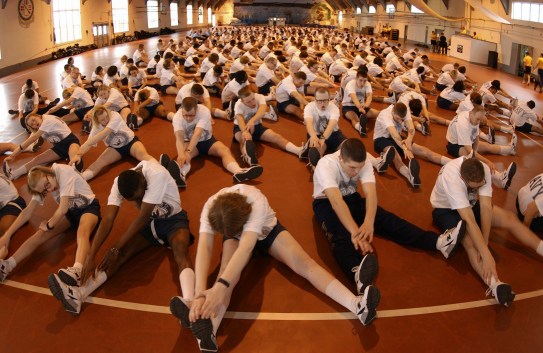
If our goal is to strengthen a tissue, is pulling red thera-band 3×10 really going to achieve that effectively? If the goal is neuro-muscluar adaptation and we need the client to go through range with a low load, then sure the 3×10 is fine. But if our goals are different shouldn’t the load we are giving also be different? Same goes for exercise prescription, no two injuries are the same, nor are no two shoulders for example. So why do we always give the same exercises? Most practitioners will tell me that “this exercise works best for this condition” and that is why they always give that particular exercise. But is it really that exercise, or is it a multitude of other factors involved, such as healing time, client perception, manual therapy, adherence to treatment, which is the cause for improvement in the condition.
I find lots of practitioners get stuck in the way they prescribe exercise. Tore your ACL? you HAVE to do these exercises, supraspinatus impingement? you HAVE to do these exercises. And with that some practitioners become exercise snobs, if it is not done “their way” its the wrong way. Or they try to come up with a novel exercise that they say is the best way to do a squat for example (no stupid that is just a regular squat!).

And that’s OK as long as it makes you think about what you are doing and why you are doing it. If you see someone with a “novel” exercise, instead of shooting it down (or building it up), step back and think of what that exercise is trying to achieve and how can it be implemented. Like I said in a previous post, if it works it works, if not its probably just another stupid modified exercise for no reason. Same goes with the treatment plans people have established through years of clinical experience. Again if it works it works, but if its not working that’s when we need to take a step back and examine what we are doing and why we are doing it. Or better yet, before implementing a treatment plan step back and ask “is this client someone who will respond well to the way I always treat an ACL, or do we need to mix things up a bit because that approach may not be as effective”.
So next time you are working with a client rehabbing an injury, don’t just spit out 3 set of 10, think about what you are trying to achieve and what load is most appropriate for that scenario. Don’t be afraid to incorporate high training loads in fear of re-injury, and also don’t be afraid of giving low level movement based activity in fear of the patient being bored or not buying-in. At the end of the day with any exercise based therapy, we are trying to optimize the load a tissue can handle and red thera-band with 3 sets of 10 can only do so much.

 korerehab.com